

“When I began to write this article, I thought it would be a quick one,” writes Jeff Price, the founder of royalty-collecting firm Audiam, in the introduction to ‘The Definitive Guide to Spotify Royalties‘.
Spoiler: it was not a quick one.
The report clocks in at 50 pages, and Price thinks that’s a comment in itself on the state of the current streaming ecosystem. “No artist, label, songwriter, distributor or musician should be required to have a depth of knowledge of this complexity to understand a very simple question: ‘How much do I earn when my music streams on Spotify?’” he writes.
“There should be a simple, easy to understand answer. But there’s not. And to be blunt, it’s not really Spotify’s fault, nor is it the music industry’s fault, or the fault of U.S. Copyright laws. But when you put all three of these things together, you get a weird franken-monster royalty schema that has resulted from a new music business model built on consumers paying to have access to music, rather than paying to own it.” We’ll let you dig in to the full report at your leisure: it covers a range of streaming services (not just Spotify) but is focused on the US system specifically. Continue below read the first section of the article.
THE TWO SEPARATE LICENSES AND THE TWO SEPARATE ROYALTIES GENERATED FOR EACH STREAM ON SPOTIFY
In order for Spotify, and other services like it, to stream a recording, they need two distinct and separate licenses. Each of those licenses result in two distinct and separate royalties. (figure 1)
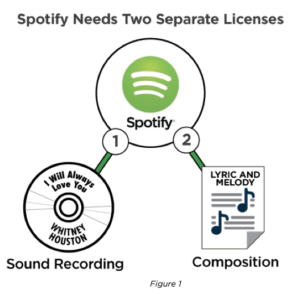 The first license earns royalties for the Sound Recording. These royalties are called “Sound Recording” royalties.
The second license earns royalties for the “Com- position/Song” or “song” (the lyric and melody). These royalties are called “music publishing” or “publisher” royalties.
Each license has its own royalty rate and rules for to calculate the royalties earned. Payments for the royalties generated by the two separate licenses are funneled through two distinct and different pipelines to get to their rightful earners.
In addition, there are different types of Spotify services available to consumers. Each type has its own distinct and unique nuances that impact how to calculate royalties. For example, the Spotify “Premium” service costs $9.99 a month to listen to music, on demand and ad-free, on any device (i.e. computer, tablet, smart phone). By contrast, Spotify’s “free” service is supported by advertisements, and allows listeners to pay nothing to listen on demand to music on any device (i.e. computer, tablet, smart phone). And Spotify offers other types of services beyond just these two. Each one of these services differs slightly from the other in regard to the formulas and rules to calculate royalties.
For simplicity’s sake, this article is going to use the Spotify Premium service in the U.S. as its example.
Now we will look at each of the two different types of royalties generated on Spotify when music streams. First, the Sound Recording royalty, and second, the Composition/Song royalty.
To read the rest of this article from Jeff Price click here.